
For the last fifty years, learning to code meant learning to think like a machine. It demanded that you memorize rigid syntax, manage memory allocation, and hunt for missing semicolons in a sea of green text. If you could not speak the machine’s language, you could not build.
That era is over.
We have moved from an era of syntax to an era of intent. This shift has given rise to a new discipline that is dominating the tech landscape in 2026: Vibe Coding.
What is Vibe Coding?
Vibe coding is the practice of building software by describing what you want in natural language and relying on Artificial Intelligence to write the actual code. Unlike traditional programming, where the developer meticulously authors every line, a vibe coder focuses entirely on the functionality, look, and “feel” of the outcome. They often accept the AI’s output without manually reviewing the underlying syntax.
The term might sound informal, but the vibe coding meaning goes deeper than slang. It describes a profound shift in abstraction. In traditional development, the coder is the worker. They are down in the trenches and laying the bricks one by one. They have total control, but they also carry the total cognitive load of implementation.
In vibe coding, the human becomes the manager. You are no longer laying the bricks. You are the Site Foreman directing a crew of hyper-fast, tireless robot workers. Your job is not to know how to mix the mortar. Your job is to look at the wall and say, “That’s crooked, fix it,” or “I want this room to feel more spacious.”
You are managing the vibe—the user experience, the flow, and the outcome—rather than the code itself.
Karpathy, Viral Tweets, and the Shift to Exponentials
While developers have been using AI autocomplete tools like GitHub Copilot since 2021, the cultural shift to “vibe coding” didn’t truly begin until early 2025. The catalyst was a post by Andrej Karpathy, a founding member of OpenAI and former Director of AI at Tesla.
In a viral post on X (formerly Twitter) in February 2025, Karpathy admitted that he had stopped writing code almost entirely. “I just fully give in to the vibes,” he wrote. “Embrace exponentials, and forget the code even exists.”
This was a watershed moment. For decades, software engineering culture prided itself on precision, “clean code,” and understanding the underlying systems. When one of the world’s most respected AI engineers gave the industry permission to “forget the code exists,” the floodgates opened. It signaled that writing syntax was no longer the high-value activity. Managing the output was.
The Three Levels of AI-Native Development
Vibe coding is not a single tool or a specific workflow. It is a philosophy that manifests across a spectrum of different platforms. Understanding where you fall on this spectrum is the first step to mastering the craft.
Level 1: Prompt-to-Website (The “Magic Wand”)
At this level, the code is completely invisible. You type a prompt, and a fully functional application appears. This is the domain of tools like Lovable and Bolt.new.
- The Experience: You type, “Create a dashboard for a coffee shop that tracks inventory and sales.” The AI generates a React application with a sidebar, charts, and tables.
- The Code: It exists in the background, but you rarely look at it. You make changes by talking to the chat interface. You might say “Make the charts green” or “Add a button to export CSV.”
- Best For: Non-technical founders building MVPs, marketers creating landing pages, and rapid prototyping.
Level 2: AI-Assisted “Tab” Coding
This is the most common form of vibe coding among professional developers. Tools like Cursor and VS Code with Copilot sit here. The code is visible, but the human isn’t typing it.
- The Experience: You write a comment like // function to calculate monthly churn, and the AI suggests the next 20 lines of code. You press the “Tab” key to accept it.
- The Vibe: You are still reading the code, but you are reading it like an editor reviews a manuscript. You are looking for logic errors rather than syntax errors.
- Best For: Experienced developers who want to move 10x faster.
Level 3: The Hybrid Agent
This is the emerging standard in 2026. Tools like Replit Agents don’t just write code. They perform tasks.
- The Experience: You give a high-level command: “Refactor the authentication system to use Supabase instead of Firebase.” The agent navigates multiple files, installs packages, updates environment variables, and rewrites the logic autonomously.
- The Vibe: You are managing a junior developer. You assign a ticket, wait for them to finish, and then review the Pull Request.
- Best For: Complex refactors and building full-stack features.
How to Vibe Code: The New Workflow
If you have never vibe coded before, the process can feel disorienting. It requires unlearning the muscle memory of traditional coding. Here is how the mechanics work in practice.
1. The “Accept All” Mentality
The hallmark of a true vibe coder is the willingness to accept AI output without scrutinizing every character. In a traditional workflow, a developer might agonize over whether to use a for loop or a map function. The vibe coder does not care. If the application works, the implementation detail is irrelevant.
This requires a psychological shift. You must trust the “probabilistic” nature of Large Language Models (LLMs). You are trading granular control for velocity.
2. Rapid Iteration via Feedback Loops
Because you are not writing the code, debugging looks different. You do not hunt for missing brackets. You treat the error as a prompt.
- Traditional Debugging: Read the stack trace, open the file, find line 42, fix the typo.
- Vibe Debugging: Copy the error message, paste it into the chat, and say, “It crashed when I clicked submit. Fix it.”
The development cycle becomes a tight loop of Prompt → Generate → Test → Re-Prompt.
3. High-Level Guidance Over Low-Level Logic
You steer the ship with product intentions rather than technical specifications.
- Instead of: “Set the div padding to 24px and use flex-direction column.”
- You say: “Give the content more room to breathe and stack the cards vertically on mobile.”
The Quality Gap: When AI Speed Creates “Slop”
If this sounds too good to be true, that is because it is. Vibe coding comes with a significant, often invisible cost.
We call this the Talented Junior Developer Problem.
Imagine you hired a junior developer who works at the speed of light. They never sleep, they know every programming language in existence, and they do exactly what you tell them to do immediately.
However, they have zero life experience. They have never seen a user struggle with a confusing menu. They do not know that light grey text on a white background is unreadable for 20% of the population. They do not care about Web Content Accessibility Guidelines (WCAG). They do not care about SEO.
If you tell this junior developer to “build a contact form,” they will build one instantly.
- Will it work? Yes.
- Will it block spam bots? Probably not.
- Will it work on an old Android phone? Maybe.
- Will it have the correct ARIA labels for screen readers? Unlikely.
This creates a phenomenon known as “Slop”. These are websites that are technically functional but qualitatively broken. They look fine at a glance (“the vibes are good”), but they are filled with invisible flaws that hurt user experience, accessibility, and search rankings.
According to data from Y Combinator’s Winter 2025 batch, nearly 25% of startups shipped codebases that were primarily AI-generated. The question for the market is no longer “Can AI build it?” The question is “Is it good enough to ship?”
The Missing Layer: Verification
In traditional development, the “code review” process catches these issues. A senior developer looks at the junior developer’s code and says, “This isn’t secure,” or “This isn’t accessible.”
In vibe coding, you are the senior developer. But if you are non-technical, or if you are simply moving too fast to check the details, who is reviewing the AI’s work?
This is where the process often breaks down. Vibe coders ship fast, but they often ship products that feel “off.” Buttons don’t provide feedback when clicked. Layouts shift unexpectedly. The copy sounds robotic.
Closing the Gap with Expert Feedback
The solution isn’t to stop vibe coding. The speed and creativity advantages are too great to ignore. The solution is to introduce a Quality Layer into your workflow.
If the AI is the “Talented Junior Developer,” you need a “Senior Developer” to review the work before it goes live. This is where Atarim fits into the vibe coding ecosystem.
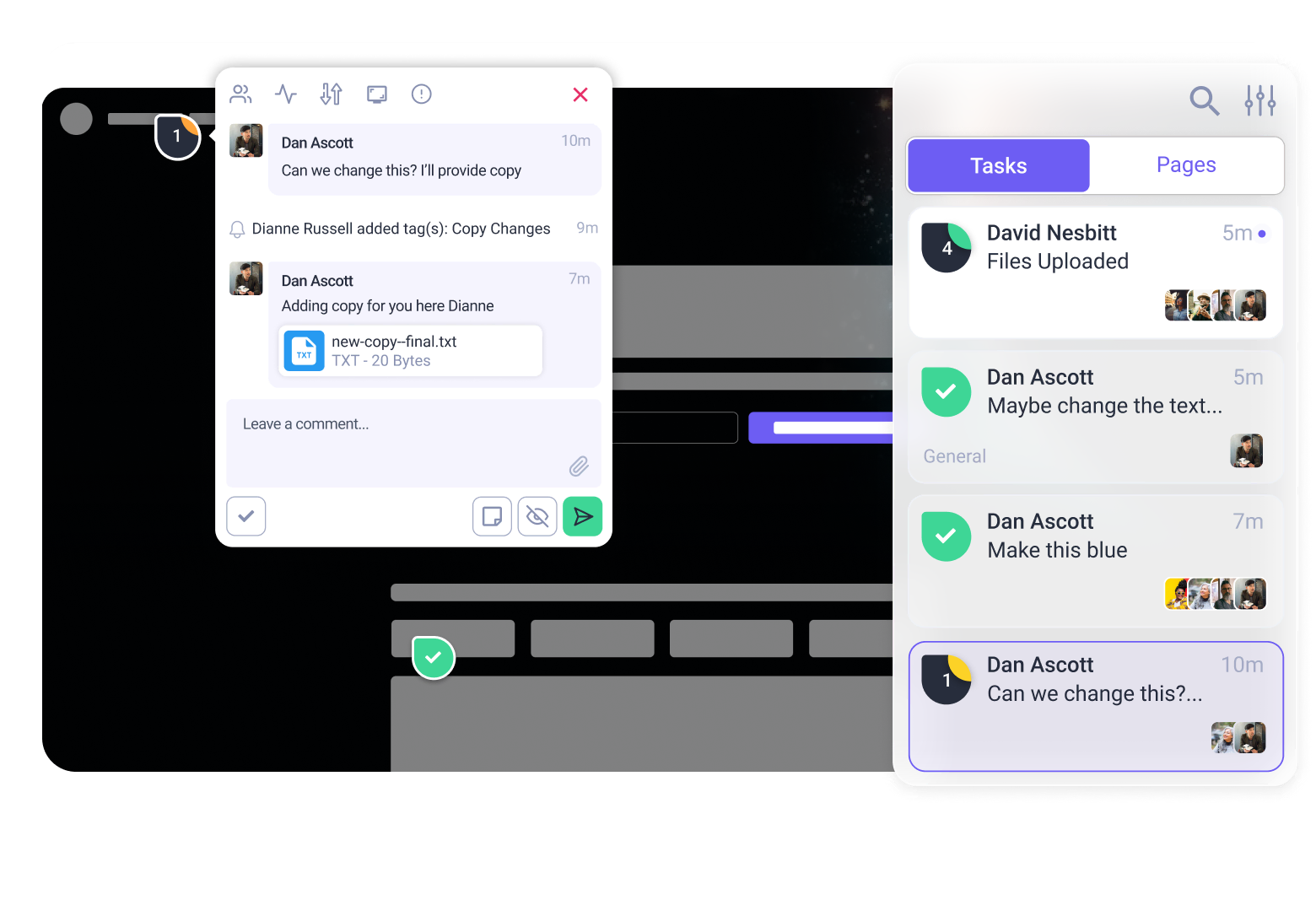
Atarim acts as the automated oversight layer for AI-generated websites. It doesn’t write code. It reviews the outcome. By scanning your vibe-coded site, Atarim’s AI agents can identify the visual, accessible, and functional issues that the build tools missed.
- Pixel checks your design consistency to ensure the AI didn’t use five different shades of blue.
- Navi ensures your site is accessible to all users, flagging contrast issues the human eye might miss.
- Glitch finds the broken links and functional errors that happen when AI hallucinates a URL.
You can move at the speed of AI, but with the confidence of an expert team.Ready to vibe code responsibly?
Don’t let invisible errors undermine your new app. Run your vibe-coded URL through Atarim’s free website checker and see exactly what the AI missed in seconds.